What is 360° HNI profiling?
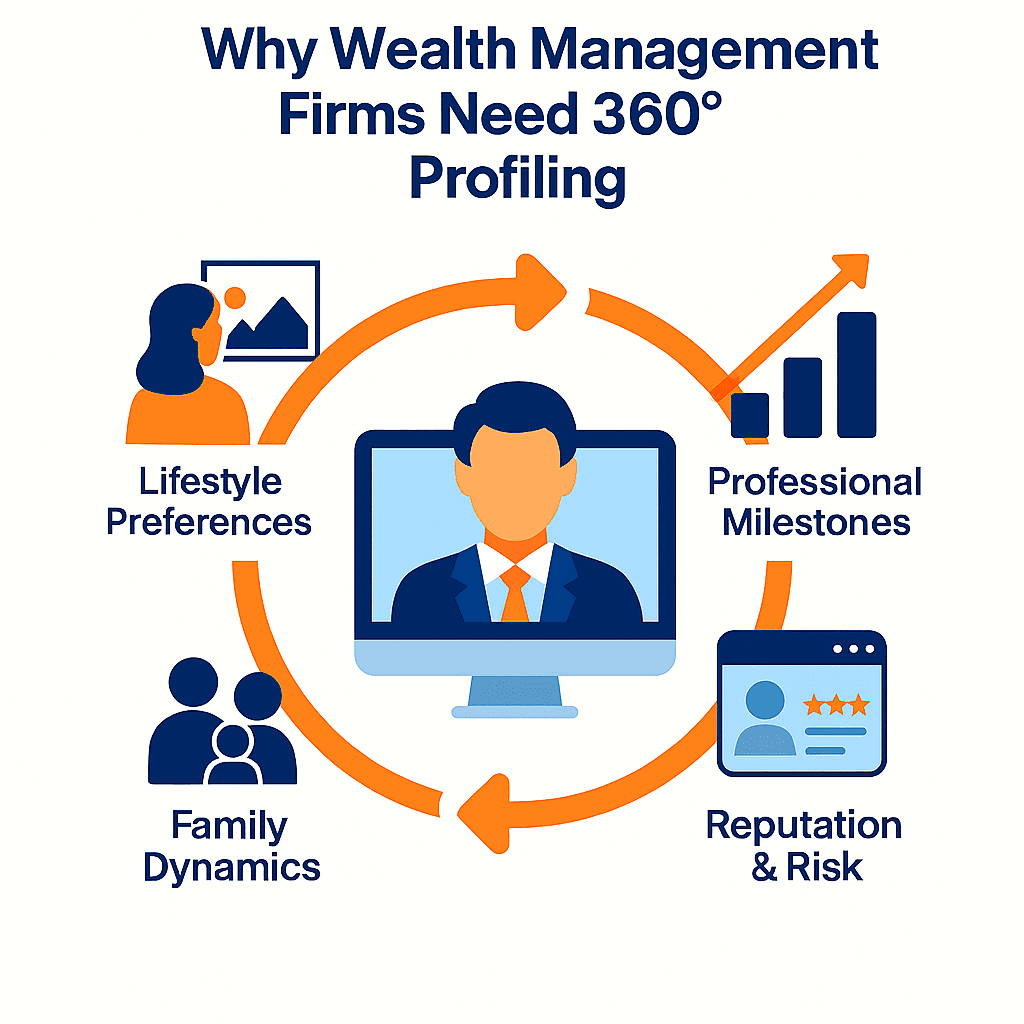
A 360° HNI profile is one record of a wealthy individual, assembled from four layers: who they are, what they do, who they know, and what has just changed about their money. It exists to answer a single question before a call, which is why this person, this month.
The four layers, and the question each one answers
Affluense builds every profile across personal, professional, social and financial layers. The personal layer carries age, education and family background. The professional layer carries current role, career history and board positions.
The social layer carries known associations, club memberships and philanthropic interests. The financial layer carries wealth events, company valuations and shareholding patterns.
The four layers do different jobs:
Personal answers who this is.
Professional answers where the income comes from.
Social answers who can make an introduction.
Financial answers why now.
Why one layer is worse than none
A record with only contact details feels finished and is not. It tells an adviser who to call, and nothing about whether the call is welcome.
A record with only a wealth estimate is worse. It puts a size on a prize without saying whether the prize is in play.
The four layers are not a completeness exercise. They work as a timing mechanism, because three of them describe a person and one of them describes a moment.
How this differs from a client risk profile
A risk profile looks backwards. It asks how someone behaved when markets fell, and it is built from a relationship that already exists.
A 360° profile looks forward. It is built before the relationship exists, from public records, and it has to survive being wrong about some of what it says.
That is the part most profiling advice skips. The record will be incomplete, and the design question is what it does with the gaps.
Why does a static HNI profile fail?
Because the verification happened once, months ago, at the moment the file was compiled. Everything that changed since then is invisible, and the reader cannot tell stale from fresh by looking.
The record decays from the edges inwards
Contact details go first. People change numbers, change roles, and stop reading an inbox that gets fifty pitches a week.
Email is the only layer with a properly published decay figure. ZeroBounce's 2026 report measured more than 11 billion addresses verified during 2025 and put the figure at 23%.
Read that carefully, because the report is often over-read. It compares annual cross-sections rather than tracking one fixed list over time, and its sample skews toward lists people already suspected were dirty. Use 23% as a direction and a scale, not as a promise about your own file.
The same report found that only 62% of the email addresses submitted to it in 2025 were valid. Roughly two in five were not.
Where the rounder numbers come from
The famous figures, 70% a year, 30% a year, 2% a month, have no traceable origin. They circulate on vendor blogs and attach to a different named study depending on which page you land on. None of those attributions resolves to a retrievable document.
Phone number invalidation and executive job-change rates sit in the same position. There is no primary study, and telecom subscriber churn is a different measure that does not stand in for it.
A profiling programme built on a number nobody can source will be defended with the same number, and the defence will not hold.
What "verified" has to mean to earn the word
Verified at compile time means the address worked in March. Verified at the moment of use means it works now. Only the second one is worth anything to a relationship manager on a Tuesday morning.
This is the practical difference between a list and a profile. A list is a snapshot with a date on the invoice. A profile is a claim that can be re-checked, and the good ones carry enough structure to make the re-check cheap.
That structure is also how you tell a real data vendor from a repackaged one. The full test set is set out in how to verify the accuracy of HNI contact data before you buy anything.
Which fields go stale first?
Ranked by decay speed, the order is contact details, then role and board positions, then ownership, then the wealth event, and last the wealth band. The band changes slowest and is the least useful field on its own.
The order, with a reason for each
Contact details change without notice and without a public record. You find out when a call fails.
Role and directorship change with a filing, but the filing arrives after the person has already moved. A resignation is recorded once it is done.
Ownership changes when shares move. Company filings capture the movement, though a private company's cap table is only as current as its last filing.
The wealth event is the fastest thing in the profile that actually matters. It also has the shortest useful life of anything in the record. Two weeks is not a quarter.
The event has a window, not a shelf life
Affluense's event table puts an approximate prospecting window on each trigger type. An IPO allotment gives two to four weeks after listing. A secondary sale gives two to four weeks.
An ESOP buyback gives one to three months, largely because of tax planning. A funding round gives three to six months. An M&A exit gives one to six months.
Those are the product's own estimates rather than a regulator's schedule, and they should be read as a working range. The point is the shape: a wealth event is perishable, and it perishes faster than any other field in the record.
That is why the event should decide which profiles get built first. Start from the event and work outwards, the way profiling HNIs quickly sets out, rather than starting from a name and hunting for a reason.
The month to month mechanics, including the filing trail for each trigger family, sit in how to track wealth events.
The unknowns column is the quality control
Every profile has fields with nothing in them. The instinct is to fill them, because an empty field looks like unfinished work.
The better move is to label them and record why. An unknown that says "no filing since 2023" is more useful than a guess that says ₹12 crore, because the first tells you what to go and check.
Where a number cannot be sourced, a range with its basis attached is the honest form. Affluense's own material is explicit that it does not produce a certified figure, which is the right posture: net worth of an HNI is an inference in India, not a field any register publishes.
How do you build a 360° profile for an Indian HNI?
In this order: the event, the person, the household, the band, then the contact. Reversing that order is what turns a research task into an afternoon of dead ends.
This is the case for event-triggered prospecting in one line. The event is the only part of the record with a deadline attached.
Start from the event, then resolve to people
A company announcement names the company and the size of the transaction. It rarely names the individuals who were paid.
That gap is the actual work. A buyback discloses an aggregate and a pool. Turning a pool into named people means reading the allotment filings, the shareholding pattern and the scheme documents, then matching those to roles.
Start with identify ESOP buybacks, which walks the filing trail for one event family. The same logic carries across the other triggers.
Join the document to a person, then to a household
The first join is document to individual. A filing carries a name and a folio. Turning that into a person means matching it against directorship records and professional profiles, and accepting that some matches will stay uncertain.
The second join is individual to household. Wealth in India frequently sits across family members, and a spouse or an adult child may hold the position that matters. Miss the household and the profile understates the relationship by a wide margin.
The third join is event to household to reason to call. Every event carries a natural next question.
A promoter stake sale raises diversification. An ESOP payout raises a tax bill with a date on it, which is a conversation with an obvious deadline.
Estimate the band, never claim the number
Affluense's tier table draws the lines at ₹5 crore to ₹25 crore for a standard HNI, ₹25 crore to ₹100 crore for a very high net worth individual, and ₹100 crore and above for an UHNI.
Those bands are a working convention rather than a statutory definition. The spread in published HNI definition work reflects exactly that.
The practical use of a band is triage. It decides which adviser takes the relationship and which product conversation is worth having first.
The number itself gets confirmed in the first conversation, by the person who owns it. A band is a triage tool. A certified figure is a liability.
Why does the wealth tier change the whole profile?
Because the same four layers get read differently at each tier, and the layer carrying the most weight shifts as the number rises.
The market underneath the tiers is thickening. India's population of people worth more than US$30 million rose 63% between 2021 and 2026, from just over 12,000 to nearly 20,000, on Knight Frank's 2026 wealth sizing model.
₹5 crore to ₹25 crore
At this tier the profile is mostly about trajectory. Senior executives, established professionals, and owners of businesses that are growing but not yet realised.
The event that matters is often a first one. An ESOP tranche, a first partial stake sale, a promotion into a role that carries equity.
The social layer matters less here than the professional layer. The network is narrower, and the introduction is more likely to come from a colleague than from a club.
₹25 crore to ₹100 crore
Founders after an exit, second generation inheritors, and business owners whose companies have re-rated.
The profile now has to carry the shape of the balance sheet, not just the source of the money. Concentrated stock is the usual problem after an exit, and the conversation that lands is about concentration rather than returns.
Multi-generational questions start at this tier too. It is also where UHNIs who prefer family offices begin to appear rather than above it.
₹100 crore and above
Promoters, serial entrepreneurs, and family office principals.
At this level the individual is often reachable only through an institution, so the profile has to describe the institution as well as the person.
Family office assets in India were estimated at roughly ₹70,000 crore in 2024, with growth of about 1.5 times expected over three years, according to the Julius Baer and EY playbook.
That same research found 40% to 45% of family office allocations going to alternatives. A profile that knows this can skip a product conversation that would have been wasted.
It also explains why segmentation by asset value alone stops working as a firm grows, which is the failure mode set out in why wealth firms fail at segmentation.
Is a public-source profile lawful to use in India?
Not automatically. "It came from a public source" is a sourcing answer rather than a legal one, and two separate regimes apply on two different dates.
The data law arrives on 13 May 2027
The Digital Personal Data Protection Act, 2023 was gazetted on 11 August 2023, but its obligations were brought into force in tranches by notification. The institutional provisions commenced on 13 November 2025.
The provisions that bind a marketing team, including consent, legitimate uses and the penalty schedule, commence on 13 May 2027.
Two details matter more than the date.
First, there is no public-data exemption in the definition of personal data. Section 2(t) is a single sentence with no carve-out.
The only public-data language sits in section 3(c)(ii), and it covers two narrow cases: data the individual published themselves, or data someone was under a legal obligation to publish.
A name lifted from a third party's filing does not obviously sit in either limb. That reading is analysis rather than statutory text, and a firm should treat it as a reason to ask counsel rather than a reason to relax.
Second, section 6(10) reverses the burden. If a firm is challenged, it must prove that notice was given and consent obtained. A purchased list cannot do that.
When the schedule does apply, a breach of "any other provision" carries a penalty extending to ₹50 crore, against ₹250 crore for a failure of security safeguards. Those are ceilings, not expectations.
The telecom rules are already live, and the sanction is a disconnection
The Telecom Commercial Communications Customer Preference Regulations were substantially rewritten by the second amendment of 12 February 2025, and they apply now.
A commercial communication is unsolicited if it matches neither the recipient's consent nor their registered preference. An unregistered sender's traffic is treated as unsolicited by definition.
The sanction for a sender is not a fine. It is a bar on outgoing services across all access providers for fifteen days on a first violation, and a one-year disconnect plus blacklisting on the second.
For a wealth firm whose desk runs on the phone, that is a harder hit than the money. There is also a re-consent bar of ninety days, so someone who opted out cannot be re-approached inside that window.
Which is why the useful question to ask of any prospect record is not whether the data was public, but whether the firm can evidence the basis on which it made the call.
What to keep on file
The record that survives a challenge is boring and specific:
Where each field came from.
When it was last confirmed.
The legal basis for processing.
Whether the person has objected, and when.
A profile with those four things attached is auditable. One without them is a spreadsheet with a compliance problem attached.
How does the profile change the first conversation?
It changes what gets said first, and it changes what never gets said at all. The test is whether the opening line would read as service or as surveillance.
Naming the event without reading as surveillance
There are three versions of the same opening:
One describes the event accurately and stops.
One describes the event, then explains what it means for the person's finances.
One recites details the person never disclosed and cannot see why you have.
Only the first one is safe. The second reads as a calculation performed on someone. The third is why people stop answering unknown numbers.
The rule that follows is simple to state. Reference the public fact, then ask a question the person is qualified to answer, and let them volunteer the rest.
What makes that possible is the difference between a record and a reason, which is the argument in context, not just contact details.
The warm path comes before the message
HSBC surveyed 9,993 affluent and high net worth investors across ten markets, including India, between 6 January and 6 February 2026.
Financial professionals were the main source of the last investment idea for 62%, against 32% for AI. At the decision point the gap widened, with 37% naming professionals as the most influential factor and 12% naming AI.
Two things follow. The professional still decides the decision. And being one of the inputs is not the same as being the one that gets chosen, which is what warm-path prospecting is built to fix.
The same survey found HNW investors above US$2 million citing professionals as their leading idea source at 70%, higher than the affluent group. The people a wealth firm most wants are the ones most likely to be advised already.
Three lines that should never open a call
Never open with the size of the money. They hold the actual number and you hold a range. The gap is not recoverable in the first minute.
Never open with an inference about the family. Household structure is the field most likely to be wrong, and the error is not recoverable politely.
Never open with a claim about their psychology. A profile can support a hypothesis about how someone makes decisions, and behavioural data, not just financial data is where that gets built carefully. What it cannot support is a stated diagnosis delivered to the person it describes.
What does a 360° profile change at the desk?
It changes the morning before it changes the quarter. The visible shift is that the team argues about which prospect, instead of arguing about whether there is anyone to call.
The week changes before the numbers do
Affluense's ROI calculator, run at ₹15 lakh crore of AUM, 500 clients and a ₹20 lakh licence cost, produces 33 new clients, ₹594 crore of added AUM and ₹5.9 crore of year-one revenue.
The same model puts lifetime value at ₹69.8 crore over ten years and research time freed at 6,250 hours a year. It also puts cost per client acquired at ₹1 lakh.
Those are model outputs at stated inputs, not measured results from a named firm. Treat them as a forecast. Every input is a field you can change.
The one worth testing first is the hour. If researching a profile takes four hours a week per adviser and the profile is the bottleneck, the freed hours are the honest part of the calculation.
The numbers worth putting on the calculator
Three numbers, in this order:
Conversations started per week per adviser.
Contact rate on the numbers the team actually dialled.
Share of those conversations that were about a live event rather than a general introduction.
The third one is the diagnostic. If the share is low, the profiling is not working, whatever the pipeline looks like.
The reason is arithmetic. Cognism's 2025 cold calling research puts average cold calling success at 2.3% and conversation success once connected at 65.6%.
That dataset is drawn from more than 204,000 calls and 27,000 conversations handled on its own platform. Getting to the conversation is the constraint, and the same data puts 93% of conversations inside three attempts and over 98% inside five.
Treat those as vendor-published figures from a company that sells contact data. They describe calls through one platform rather than the market. The shape still holds: the bottleneck is reaching a person at all, which is what a timed reason to call solves.
Where profiling programmes stall
They stall at the handover. A profile that lives in a research tool and never reaches the CRM is a document.
They stall at refresh. A profile built once and never re-checked is a list with extra steps.
They stall at the tier boundary. A firm that builds deep profiles only for the top tier and thin ones for everyone else usually finds the referrals come from the middle.
And they stall when the profile becomes the deliverable. The profile is the preparation. The call is the work.
Frequently asked questions
What is the difference between a 360 degree HNI profile and an HNI database?
A database gives you a record and a compile date. A 360 degree profile gives you a record, a set of fields that are each dated separately, and a reason to call this month.
The difference between a profile and an HNI database in India comes down to which fields can be re-checked and how recently they were.
Can you build a 360 degree profile from public data alone?
For the professional, ownership and event layers, largely yes, provided the firm is willing to record what it does not know.
For contact details, and for anything about family or health, public records will not get you there. A profile that pretends otherwise is guessing.
Affluense publishes verified professional and business profiles for exactly the layers public records can support.
How often does a 360 degree HNI profile need refreshing?
Different fields carry different clocks:
The event layer needs checking continuously, because it is the one with a window.
Role and ownership need checking on filing cycles.
Contact details need checking at the moment of use.
The wealth band is the slowest and can usually stand for a year.
Does 360 degree profiling work below the top tier?
It is most valuable there. The upper tiers are already covered by existing relationships and, in many cases, by a family office.
The ₹5 crore to ₹25 crore band is where a first wealth event creates a first decision. It is also where a well-timed, well-sourced approach is most likely to be the one that gets answered.
Two companion pieces go deeper. What wealth firms miss about HNI psychology covers the decision behaviour, and investment behavior during wealth transitions covers the transition mechanics.
A profile is only worth building if it changes what you say first. Start with one live event and one real prospect, and see whether the conversation is better. Book a demo and bring a name you already know.
Sources
Affluense. "HNI Database India." Affluense, affluense.ai/hni-database-india. Accessed 20 Nov. 2026.
Affluense. "ROI Calculator." Affluense, affluense.ai/roi. Accessed 20 Nov. 2026.
Cognism. "45+ Key B2B Cold Calling Statistics." Cognism, 19 Mar. 2025, updated 7 May 2026, cognism.com/blog/cold-calling-statistics.
HSBC. The Trust Threshold: AI Makes Investors Bolder, but They Want Human Judgement to Make Decisions. HSBC, 24 June 2026, hsbc.com/news-and-views/news/media-releases/2026/the-trust-threshold-ai-makes-investors-bolder-but-they-want-human-judgement-to-make-decisions.
Julius Baer and EY. Indian Family Office Playbook: Now, Next and Beyond. EY India, 20 Aug. 2026, ey.com/en_in/newsroom/2026/08/indian-family-office-assets-projected-to-grow-1-point-5x-over-the-next-three-years-julius-baer-ey-report.
Knight Frank. The Wealth Report 2026. 20th ed., Knight Frank, 23 Apr. 2026, knightfrank.com/research/article/2026/4/wealth-sizing-model-2026-results.
Ministry of Electronics and Information Technology. The Digital Personal Data Protection Act, 2023. Act 22 of 2023, Gazette of India, 11 Aug. 2023, indiankanoon.org/doc/3510545/.
Telecom Regulatory Authority of India. Telecom Commercial Communications Customer Preference (Second Amendment) Regulations, 2025. No. 1 of 2025, 12 Feb. 2025, legitquest.com/act/telecom-commercial-communications-customer-preference-second-amendment-regulations-2025/10A6C.
ZeroBounce. The Email List Decay Report for 2026. ZeroBounce, 2026, zerobounce.net/email-list-decay.
What is 360° HNI profiling?
A 360° HNI profile is one record of a wealthy individual, assembled from four layers: who they are, what they do, who they know, and what has just changed about their money. It exists to answer a single question before a call, which is why this person, this month.
The four layers, and the question each one answers
Affluense builds every profile across personal, professional, social and financial layers. The personal layer carries age, education and family background. The professional layer carries current role, career history and board positions.
The social layer carries known associations, club memberships and philanthropic interests. The financial layer carries wealth events, company valuations and shareholding patterns.
The four layers do different jobs:
Personal answers who this is.
Professional answers where the income comes from.
Social answers who can make an introduction.
Financial answers why now.
Why one layer is worse than none
A record with only contact details feels finished and is not. It tells an adviser who to call, and nothing about whether the call is welcome.
A record with only a wealth estimate is worse. It puts a size on a prize without saying whether the prize is in play.
The four layers are not a completeness exercise. They work as a timing mechanism, because three of them describe a person and one of them describes a moment.
How this differs from a client risk profile
A risk profile looks backwards. It asks how someone behaved when markets fell, and it is built from a relationship that already exists.
A 360° profile looks forward. It is built before the relationship exists, from public records, and it has to survive being wrong about some of what it says.
That is the part most profiling advice skips. The record will be incomplete, and the design question is what it does with the gaps.
Why does a static HNI profile fail?
Because the verification happened once, months ago, at the moment the file was compiled. Everything that changed since then is invisible, and the reader cannot tell stale from fresh by looking.
The record decays from the edges inwards
Contact details go first. People change numbers, change roles, and stop reading an inbox that gets fifty pitches a week.
Email is the only layer with a properly published decay figure. ZeroBounce's 2026 report measured more than 11 billion addresses verified during 2025 and put the figure at 23%.
Read that carefully, because the report is often over-read. It compares annual cross-sections rather than tracking one fixed list over time, and its sample skews toward lists people already suspected were dirty. Use 23% as a direction and a scale, not as a promise about your own file.
The same report found that only 62% of the email addresses submitted to it in 2025 were valid. Roughly two in five were not.
Where the rounder numbers come from
The famous figures, 70% a year, 30% a year, 2% a month, have no traceable origin. They circulate on vendor blogs and attach to a different named study depending on which page you land on. None of those attributions resolves to a retrievable document.
Phone number invalidation and executive job-change rates sit in the same position. There is no primary study, and telecom subscriber churn is a different measure that does not stand in for it.
A profiling programme built on a number nobody can source will be defended with the same number, and the defence will not hold.
What "verified" has to mean to earn the word
Verified at compile time means the address worked in March. Verified at the moment of use means it works now. Only the second one is worth anything to a relationship manager on a Tuesday morning.
This is the practical difference between a list and a profile. A list is a snapshot with a date on the invoice. A profile is a claim that can be re-checked, and the good ones carry enough structure to make the re-check cheap.
That structure is also how you tell a real data vendor from a repackaged one. The full test set is set out in how to verify the accuracy of HNI contact data before you buy anything.
Which fields go stale first?
Ranked by decay speed, the order is contact details, then role and board positions, then ownership, then the wealth event, and last the wealth band. The band changes slowest and is the least useful field on its own.
The order, with a reason for each
Contact details change without notice and without a public record. You find out when a call fails.
Role and directorship change with a filing, but the filing arrives after the person has already moved. A resignation is recorded once it is done.
Ownership changes when shares move. Company filings capture the movement, though a private company's cap table is only as current as its last filing.
The wealth event is the fastest thing in the profile that actually matters. It also has the shortest useful life of anything in the record. Two weeks is not a quarter.
The event has a window, not a shelf life
Affluense's event table puts an approximate prospecting window on each trigger type. An IPO allotment gives two to four weeks after listing. A secondary sale gives two to four weeks.
An ESOP buyback gives one to three months, largely because of tax planning. A funding round gives three to six months. An M&A exit gives one to six months.
Those are the product's own estimates rather than a regulator's schedule, and they should be read as a working range. The point is the shape: a wealth event is perishable, and it perishes faster than any other field in the record.
That is why the event should decide which profiles get built first. Start from the event and work outwards, the way profiling HNIs quickly sets out, rather than starting from a name and hunting for a reason.
The month to month mechanics, including the filing trail for each trigger family, sit in how to track wealth events.
The unknowns column is the quality control
Every profile has fields with nothing in them. The instinct is to fill them, because an empty field looks like unfinished work.
The better move is to label them and record why. An unknown that says "no filing since 2023" is more useful than a guess that says ₹12 crore, because the first tells you what to go and check.
Where a number cannot be sourced, a range with its basis attached is the honest form. Affluense's own material is explicit that it does not produce a certified figure, which is the right posture: net worth of an HNI is an inference in India, not a field any register publishes.
How do you build a 360° profile for an Indian HNI?
In this order: the event, the person, the household, the band, then the contact. Reversing that order is what turns a research task into an afternoon of dead ends.
This is the case for event-triggered prospecting in one line. The event is the only part of the record with a deadline attached.
Start from the event, then resolve to people
A company announcement names the company and the size of the transaction. It rarely names the individuals who were paid.
That gap is the actual work. A buyback discloses an aggregate and a pool. Turning a pool into named people means reading the allotment filings, the shareholding pattern and the scheme documents, then matching those to roles.
Start with identify ESOP buybacks, which walks the filing trail for one event family. The same logic carries across the other triggers.
Join the document to a person, then to a household
The first join is document to individual. A filing carries a name and a folio. Turning that into a person means matching it against directorship records and professional profiles, and accepting that some matches will stay uncertain.
The second join is individual to household. Wealth in India frequently sits across family members, and a spouse or an adult child may hold the position that matters. Miss the household and the profile understates the relationship by a wide margin.
The third join is event to household to reason to call. Every event carries a natural next question.
A promoter stake sale raises diversification. An ESOP payout raises a tax bill with a date on it, which is a conversation with an obvious deadline.
Estimate the band, never claim the number
Affluense's tier table draws the lines at ₹5 crore to ₹25 crore for a standard HNI, ₹25 crore to ₹100 crore for a very high net worth individual, and ₹100 crore and above for an UHNI.
Those bands are a working convention rather than a statutory definition. The spread in published HNI definition work reflects exactly that.
The practical use of a band is triage. It decides which adviser takes the relationship and which product conversation is worth having first.
The number itself gets confirmed in the first conversation, by the person who owns it. A band is a triage tool. A certified figure is a liability.
Why does the wealth tier change the whole profile?
Because the same four layers get read differently at each tier, and the layer carrying the most weight shifts as the number rises.
The market underneath the tiers is thickening. India's population of people worth more than US$30 million rose 63% between 2021 and 2026, from just over 12,000 to nearly 20,000, on Knight Frank's 2026 wealth sizing model.
₹5 crore to ₹25 crore
At this tier the profile is mostly about trajectory. Senior executives, established professionals, and owners of businesses that are growing but not yet realised.
The event that matters is often a first one. An ESOP tranche, a first partial stake sale, a promotion into a role that carries equity.
The social layer matters less here than the professional layer. The network is narrower, and the introduction is more likely to come from a colleague than from a club.
₹25 crore to ₹100 crore
Founders after an exit, second generation inheritors, and business owners whose companies have re-rated.
The profile now has to carry the shape of the balance sheet, not just the source of the money. Concentrated stock is the usual problem after an exit, and the conversation that lands is about concentration rather than returns.
Multi-generational questions start at this tier too. It is also where UHNIs who prefer family offices begin to appear rather than above it.
₹100 crore and above
Promoters, serial entrepreneurs, and family office principals.
At this level the individual is often reachable only through an institution, so the profile has to describe the institution as well as the person.
Family office assets in India were estimated at roughly ₹70,000 crore in 2024, with growth of about 1.5 times expected over three years, according to the Julius Baer and EY playbook.
That same research found 40% to 45% of family office allocations going to alternatives. A profile that knows this can skip a product conversation that would have been wasted.
It also explains why segmentation by asset value alone stops working as a firm grows, which is the failure mode set out in why wealth firms fail at segmentation.
Is a public-source profile lawful to use in India?
Not automatically. "It came from a public source" is a sourcing answer rather than a legal one, and two separate regimes apply on two different dates.
The data law arrives on 13 May 2027
The Digital Personal Data Protection Act, 2023 was gazetted on 11 August 2023, but its obligations were brought into force in tranches by notification. The institutional provisions commenced on 13 November 2025.
The provisions that bind a marketing team, including consent, legitimate uses and the penalty schedule, commence on 13 May 2027.
Two details matter more than the date.
First, there is no public-data exemption in the definition of personal data. Section 2(t) is a single sentence with no carve-out.
The only public-data language sits in section 3(c)(ii), and it covers two narrow cases: data the individual published themselves, or data someone was under a legal obligation to publish.
A name lifted from a third party's filing does not obviously sit in either limb. That reading is analysis rather than statutory text, and a firm should treat it as a reason to ask counsel rather than a reason to relax.
Second, section 6(10) reverses the burden. If a firm is challenged, it must prove that notice was given and consent obtained. A purchased list cannot do that.
When the schedule does apply, a breach of "any other provision" carries a penalty extending to ₹50 crore, against ₹250 crore for a failure of security safeguards. Those are ceilings, not expectations.
The telecom rules are already live, and the sanction is a disconnection
The Telecom Commercial Communications Customer Preference Regulations were substantially rewritten by the second amendment of 12 February 2025, and they apply now.
A commercial communication is unsolicited if it matches neither the recipient's consent nor their registered preference. An unregistered sender's traffic is treated as unsolicited by definition.
The sanction for a sender is not a fine. It is a bar on outgoing services across all access providers for fifteen days on a first violation, and a one-year disconnect plus blacklisting on the second.
For a wealth firm whose desk runs on the phone, that is a harder hit than the money. There is also a re-consent bar of ninety days, so someone who opted out cannot be re-approached inside that window.
Which is why the useful question to ask of any prospect record is not whether the data was public, but whether the firm can evidence the basis on which it made the call.
What to keep on file
The record that survives a challenge is boring and specific:
Where each field came from.
When it was last confirmed.
The legal basis for processing.
Whether the person has objected, and when.
A profile with those four things attached is auditable. One without them is a spreadsheet with a compliance problem attached.
How does the profile change the first conversation?
It changes what gets said first, and it changes what never gets said at all. The test is whether the opening line would read as service or as surveillance.
Naming the event without reading as surveillance
There are three versions of the same opening:
One describes the event accurately and stops.
One describes the event, then explains what it means for the person's finances.
One recites details the person never disclosed and cannot see why you have.
Only the first one is safe. The second reads as a calculation performed on someone. The third is why people stop answering unknown numbers.
The rule that follows is simple to state. Reference the public fact, then ask a question the person is qualified to answer, and let them volunteer the rest.
What makes that possible is the difference between a record and a reason, which is the argument in context, not just contact details.
The warm path comes before the message
HSBC surveyed 9,993 affluent and high net worth investors across ten markets, including India, between 6 January and 6 February 2026.
Financial professionals were the main source of the last investment idea for 62%, against 32% for AI. At the decision point the gap widened, with 37% naming professionals as the most influential factor and 12% naming AI.
Two things follow. The professional still decides the decision. And being one of the inputs is not the same as being the one that gets chosen, which is what warm-path prospecting is built to fix.
The same survey found HNW investors above US$2 million citing professionals as their leading idea source at 70%, higher than the affluent group. The people a wealth firm most wants are the ones most likely to be advised already.
Three lines that should never open a call
Never open with the size of the money. They hold the actual number and you hold a range. The gap is not recoverable in the first minute.
Never open with an inference about the family. Household structure is the field most likely to be wrong, and the error is not recoverable politely.
Never open with a claim about their psychology. A profile can support a hypothesis about how someone makes decisions, and behavioural data, not just financial data is where that gets built carefully. What it cannot support is a stated diagnosis delivered to the person it describes.
What does a 360° profile change at the desk?
It changes the morning before it changes the quarter. The visible shift is that the team argues about which prospect, instead of arguing about whether there is anyone to call.
The week changes before the numbers do
Affluense's ROI calculator, run at ₹15 lakh crore of AUM, 500 clients and a ₹20 lakh licence cost, produces 33 new clients, ₹594 crore of added AUM and ₹5.9 crore of year-one revenue.
The same model puts lifetime value at ₹69.8 crore over ten years and research time freed at 6,250 hours a year. It also puts cost per client acquired at ₹1 lakh.
Those are model outputs at stated inputs, not measured results from a named firm. Treat them as a forecast. Every input is a field you can change.
The one worth testing first is the hour. If researching a profile takes four hours a week per adviser and the profile is the bottleneck, the freed hours are the honest part of the calculation.
The numbers worth putting on the calculator
Three numbers, in this order:
Conversations started per week per adviser.
Contact rate on the numbers the team actually dialled.
Share of those conversations that were about a live event rather than a general introduction.
The third one is the diagnostic. If the share is low, the profiling is not working, whatever the pipeline looks like.
The reason is arithmetic. Cognism's 2025 cold calling research puts average cold calling success at 2.3% and conversation success once connected at 65.6%.
That dataset is drawn from more than 204,000 calls and 27,000 conversations handled on its own platform. Getting to the conversation is the constraint, and the same data puts 93% of conversations inside three attempts and over 98% inside five.
Treat those as vendor-published figures from a company that sells contact data. They describe calls through one platform rather than the market. The shape still holds: the bottleneck is reaching a person at all, which is what a timed reason to call solves.
Where profiling programmes stall
They stall at the handover. A profile that lives in a research tool and never reaches the CRM is a document.
They stall at refresh. A profile built once and never re-checked is a list with extra steps.
They stall at the tier boundary. A firm that builds deep profiles only for the top tier and thin ones for everyone else usually finds the referrals come from the middle.
And they stall when the profile becomes the deliverable. The profile is the preparation. The call is the work.
Frequently asked questions
What is the difference between a 360 degree HNI profile and an HNI database?
A database gives you a record and a compile date. A 360 degree profile gives you a record, a set of fields that are each dated separately, and a reason to call this month.
The difference between a profile and an HNI database in India comes down to which fields can be re-checked and how recently they were.
Can you build a 360 degree profile from public data alone?
For the professional, ownership and event layers, largely yes, provided the firm is willing to record what it does not know.
For contact details, and for anything about family or health, public records will not get you there. A profile that pretends otherwise is guessing.
Affluense publishes verified professional and business profiles for exactly the layers public records can support.
How often does a 360 degree HNI profile need refreshing?
Different fields carry different clocks:
The event layer needs checking continuously, because it is the one with a window.
Role and ownership need checking on filing cycles.
Contact details need checking at the moment of use.
The wealth band is the slowest and can usually stand for a year.
Does 360 degree profiling work below the top tier?
It is most valuable there. The upper tiers are already covered by existing relationships and, in many cases, by a family office.
The ₹5 crore to ₹25 crore band is where a first wealth event creates a first decision. It is also where a well-timed, well-sourced approach is most likely to be the one that gets answered.
Two companion pieces go deeper. What wealth firms miss about HNI psychology covers the decision behaviour, and investment behavior during wealth transitions covers the transition mechanics.
A profile is only worth building if it changes what you say first. Start with one live event and one real prospect, and see whether the conversation is better. Book a demo and bring a name you already know.
Sources
Affluense. "HNI Database India." Affluense, affluense.ai/hni-database-india. Accessed 20 Nov. 2026.
Affluense. "ROI Calculator." Affluense, affluense.ai/roi. Accessed 20 Nov. 2026.
Cognism. "45+ Key B2B Cold Calling Statistics." Cognism, 19 Mar. 2025, updated 7 May 2026, cognism.com/blog/cold-calling-statistics.
HSBC. The Trust Threshold: AI Makes Investors Bolder, but They Want Human Judgement to Make Decisions. HSBC, 24 June 2026, hsbc.com/news-and-views/news/media-releases/2026/the-trust-threshold-ai-makes-investors-bolder-but-they-want-human-judgement-to-make-decisions.
Julius Baer and EY. Indian Family Office Playbook: Now, Next and Beyond. EY India, 20 Aug. 2026, ey.com/en_in/newsroom/2026/08/indian-family-office-assets-projected-to-grow-1-point-5x-over-the-next-three-years-julius-baer-ey-report.
Knight Frank. The Wealth Report 2026. 20th ed., Knight Frank, 23 Apr. 2026, knightfrank.com/research/article/2026/4/wealth-sizing-model-2026-results.
Ministry of Electronics and Information Technology. The Digital Personal Data Protection Act, 2023. Act 22 of 2023, Gazette of India, 11 Aug. 2023, indiankanoon.org/doc/3510545/.
Telecom Regulatory Authority of India. Telecom Commercial Communications Customer Preference (Second Amendment) Regulations, 2025. No. 1 of 2025, 12 Feb. 2025, legitquest.com/act/telecom-commercial-communications-customer-preference-second-amendment-regulations-2025/10A6C.
ZeroBounce. The Email List Decay Report for 2026. ZeroBounce, 2026, zerobounce.net/email-list-decay.